
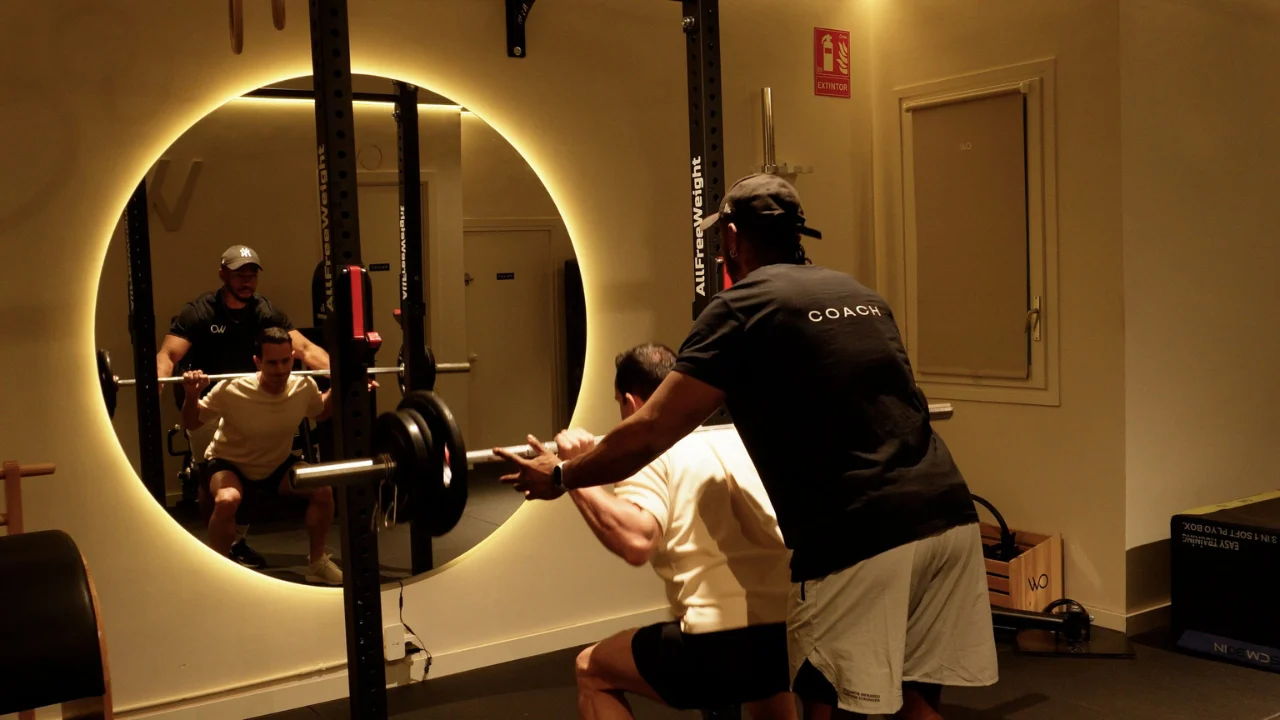
Online personal training works as well as in-person for most clients, and for some it works better. Results in personal training come from programming, technique and consistency, not from a coach being in the same room. When the structure is solid and communication stays open, distance stops mattering. The clients who do well online are the ones who engage with the app and stay in touch between sessions.
Most people walk into the first conversation assuming online training is the lesser option, a cheaper compromise for clients who can’t reach a studio. That assumption is reasonable, but it doesn’t match what I see with the clients who train with me this way. For many of them, online has been the better fit, not the second-best one.
I coach English and Spanish speaking clients online from anywhere in Spain, and the structure of what we do isn’t a downgrade from in-person sessions. It’s the same program, delivered differently. Below is the honest version of how that works, who it suits, and where the format doesn’t fit.
Why people doubt online personal training
Three objections come up in every first call. Each one has a real answer.
“How can you correct my form through a screen?”
Most people picture form correction as a coach standing next to them, nudging their hips or tapping their shoulder. That happens in person, but it isn’t where most of the work actually gets done.
Form review works through video. You film a working set on your phone, send it through Trainerize, then I review it . The advantage isn’t only being able to see it, it’s that I can rewatch it, slow it down, scrub between frames and compare your last set against the one from three weeks ago. In a studio, I see one rep at one angle in real time. On video, I see every rep at the angle that actually shows the movement.
Clients sometimes find it awkward to start with. Within a few weeks, most prefer it.
“I won’t stay accountable without someone in the room”
Accountability isn’t physical, it’s structural. A trainer in the room with you for fifty minutes a week doesn’t create accountability. The structure does. Showing up to a scheduled session creates accountability. Logging your sets after every workout creates accountability. Knowing your coach will see whether you trained on Tuesday creates accountability.
Online training, set up properly, has all of that. Through the app we track every session, we check in weekly, you can message me between sessions and I’ll reply within the day. The accountability is the same, the format just changes.
What does break the system is when a client knows they won’t open the app. That’s a fit question, and I’ll come back to it.
“I don’t have the equipment”
Most clients have more than they think. A pull-up bar in a doorway, a set of adjustable dumbbells, a band and a bench cover the majority of programs I build. Many clients add a basic gym membership for the heavier compound work, others train entirely from home with a kit that fits under a bed.
If you genuinely have nothing, we plan around that. Bodyweight progressions, isometrics, single-leg variations. The program adapts to what you have, not the other way around.
What actually drives results in personal training
This is the part most people don’t think through. When you strip a training session down to what makes it work, three things are doing the load-bearing.
The first is programming. The right exercises in the right order, the right volume per week, the right progression from one week to the next. None of this requires me to be in the room. It requires me to know your training history, your goals, your equipment and your recovery, and to build a plan that fits.
The second is technique. Knowing when to push for another rep and when to call the set, when a movement is loaded enough and when it isn’t. This is teachable through video, and once it’s taught, it sticks. Clients I haven’t trained in person for months still have the form I taught them.
The third is consistency. The single biggest predictor of results in any training context isn’t intensity or program quality, it’s the number of weeks the client kept showing up. Online removes the friction that breaks consistency, the commute, the rigid time slot, the bad weather, the work trip. You train when it fits, in the space you’ve got.
Online and in-person, where they actually differ
It helps to see the two formats side by side, because the differences are smaller than most people expect.
| What it covers | In-person | Online |
|---|---|---|
| Programming | Built around your goals and history | Built around your goals and history |
| Technique coaching | Live cues in the moment | Video review, often more thorough |
| Accountability | Scheduled session, in-person | Scheduled session, app tracking, weekly check-ins |
| Between-session contact | Limited | Direct messaging, same-day replies |
| Schedule flexibility | Tied to studio hours | Anywhere with a stable connection |
| Equipment | Studio kit available | Your kit, home gym or basic gym membership |
| Best for | Clients near the studio who want hands-on cueing | Clients elsewhere in Spain, frequent travellers, clients who want flexibility |
How online training works at Davephysik
The week, in practice:
- Sunday evening, the upcoming week’s program lands in Trainerize. Three sessions, each with the exercises, sets, reps and load targets ready
- You train on the days you’ve planned, log every set as you go
- Once a week you film one working set for review, usually the main lift of the session
- I review the video, send notes back through the app, and adjust load or progression for the following week
- You message me between sessions when something comes up, an awkward shoulder, a missed day, a hotel gym layout. I reply the same day or the next
What you don’t get is a coach watching you in real time. What you do get is a coach paying attention to your training every week, with a record of every session you’ve done since you started. That second thing is what actually moves you forward.
Who online personal training works best for
Online training is a strong fit if any of this sounds like you:
- You live outside Barcelona but want bilingual coaching from someone who knows your goals. Madrid, Valencia, Seville, Mallorca, the Canaries, the Costa del Sol, anywhere with a stable internet connection
- You moved out of Barcelona and want to keep training with someone you trust, in the language you prefer
- You travel for work and need a program that runs in your home gym, your local gym and four hotel gyms a year
- You want the structure of personal training without the commute, the locker room or the studio time slot
- You speak Spanish and you’re tired of online programs that translate the same generic plan word for word
It’s less of a fit if you know yourself well enough to know you won’t open the app, or if you’re rehabbing a specific injury that needs hands-on assessment from someone in the room. Those clients I’d send to a local trainer or physio. The discipline is the whole game, and I’d rather be honest about that than take on someone the format won’t serve.
Bilingual from day one, not as a feature
Most online personal training in Spain is English-only or Spanish-only. The bilingual offering, where it exists, tends to be a translation layer over a single-language program.
At Davephysik, the coaching runs in either language, by choice, with the same coach. Your form-check videos can be in Spanish, your weekly check-ins in English if that’s what fits the week. The program doesn’t change, the communication adapts.
What a typical online client looks like
A few patterns recur. A 34-year-old expat in Madrid who’s lifted on and off for years and wants structure for the first time. A returning client in Sabadell who used to train with me in Caldes and moved further out of the city. A Spanish professional in Valencia who’s spent two years on apps without a coach and is tired of guessing. A frequent traveller based in Barcelona who’s online three months of the year and at my studio the other nine.
These aren’t separate audiences, they’re variations on the same need, structured strength training, by someone who’s paying attention, in the language they prefer, in the space they’ve got.
At Davephysik
At Davephysik, I coach clients online from anywhere in Spain, with the same structured 1-on-1 personal training and weekly programming that runs in my studios in Gràcia, L’Eixample and Caldes de Montbui. Whether you’re in Madrid, Mallorca or three streets from my Eixample studio, the program is built around your body, your goals and the equipment you’ve got.
Book a free 30-minute video call
Frequently asked questions
Does online personal training actually work?
For most clients, yes. Results in personal training come from programming, technique and consistency rather than physical proximity, and online training delivers all three when it’s structured properly. The clients who do well online are the ones who engage with the app and stay communicative between sessions.
Do I need a home gym for online personal training?
No. Most online programs run on a pull-up bar, a set of adjustable dumbbells, a band and a bench. Many clients use a basic gym membership for heavier compound work. If you have nothing, the program adapts around bodyweight progressions and isometrics.
How does form correction work without being in the same room?
You film a working set and send it through Trainerize. I review it the same day, often more thoroughly than I could in a studio, because video lets me rewatch, slow down and compare against previous weeks. Notes and adjustments come back the same day.
Can I switch between online and in-person sessions?
Yes. Clients who live in Barcelona often combine the two, training in person at my Gràcia, L’Eixample or Caldes studios and continuing the program online when they travel or when the schedule tightens up. The program continues without resetting.
Is online personal training available in Spanish?
Yes. I coach in English and Spanish, and clients choose which language fits each session and each check-in. The program doesn’t change between languages, the communication adapts.